|
|
What is Krill? Krill: an abundant renewable resource
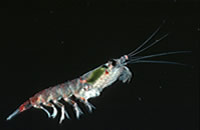
Krill is a generic term used to designate all deepwater marine planktonic crustacean species. It looks like miniature shrimp, ranging between one and six centimeters in length. These 85 species represents the planet's most abundant animal biomass found in banks that may extend over several square kilometers. Krill fisheries can mainly be found in two ocean regions: the Antarctic Ocean and the North Pacific Ocean, along the Canadian and Japanese coasts. According to a World Health Organization estimate, the total quantity of krill in these two oceans exceeds 500 million tons. Approximately 110,000 tons of krill are harvested every year, or about less than one-half of 0.1% of the existing resources.
Krill supply
In November 2001, Neptune entered into an agreement with a Japanese company, the world leader in the krill fishery industry. The agreement guarantees Neptune the raw krill supply necessary to fulfill its volume requirements. The agreement stipulates that the Japanese company will allocate two of its vessels to harvest krill for Neptune. These vessels and their fishing techniques will meet Neptune's quality and volume requirements.
 |
 |
A Single Krill |
Thousands of Krill |
|


